





![[Crypto Class 3] One Wrong Send: Can You Undo It?](http://store.dcentwallet.com/cdn/shop/articles/3_EN_92b13c14-57be-4a1d-ba45-7176fb52decc.jpg?v=1784594158&width=1100)

So far we've talked about "loss" and "storage." Today we look at a different kind of risk: a mistake in the very moment you send assets. It can happen to anyone, beginner or expert, and once it does, it's hard to undo.
$220,000 Gone in the Time It Takes to Paste Once
In July 2026, one user lost about $220,000 worth of tokens. It wasn't a hack, and it wasn't a scam. In the field for the recipient's address, they accidentally pasted the token's "contract address" instead.
It was a single copy-and-paste. And the money never came back. A contract address has no "owner" to return the funds, so there was simply no way to recover it.

Crypto Has No "Undo" Button
With a bank transfer, a wrong send can often be canceled or clawed back. Crypto is different. Once a transaction is written to the blockchain, it cannot be reversed.
If you send to the wrong address, your only hope is that its owner voluntarily returns it. And if you don't know who they are, or — as above — the address has no owner at all, even that isn't possible.
Mistakes Happen in Three Main Places
Mistakes in the moment of sending usually fall into one of these three.
1. Entering the wrong address
Copying the recipient address incorrectly, or, as above, pasting the wrong address entirely. Addresses are long and complex, hard to fully verify by eye.
2. Confusing the network
Even for the same coin, picking the wrong network (chain) can leave your assets stranded somewhere unexpected, or lost.
3. Omitting a required value
Some values must be included, like XRP's destination tag or Stellar's memo. Skip them, and you can end up unable to locate your assets at an exchange.
Checking Before You Send Is the Last Line of Defense
These mistakes share one thing in common: a single proper check right before sending could have prevented them.
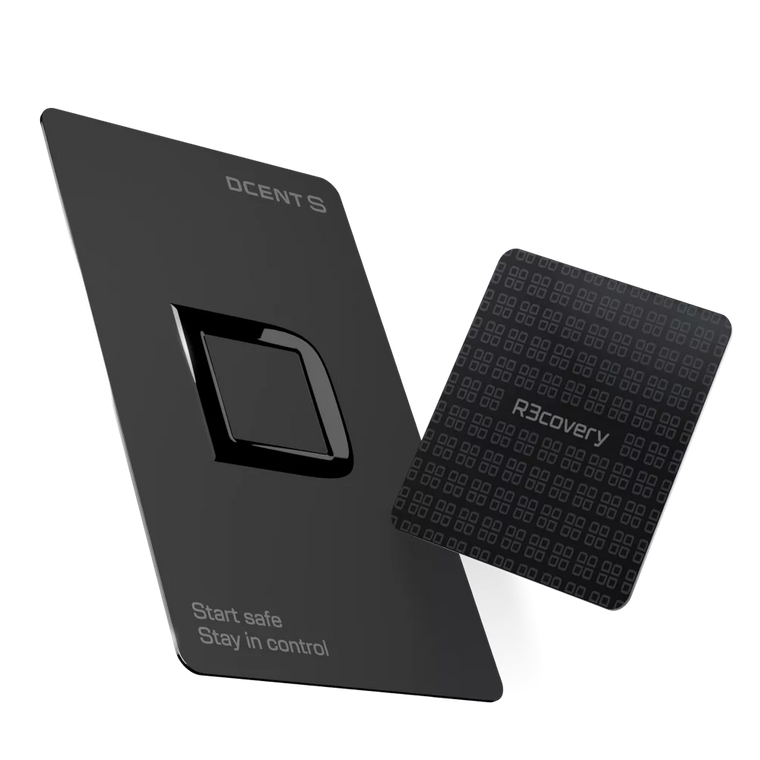
The DCENT S card has no screen, so when you send assets you review the recipient address, amount, and network directly in the DCENT app (Clear Review) before signing. The app naturally builds the habit of giving what's on screen one more look.
People Still Slip Up — So, One More Layer
No matter how careful you are, when you're rushed or too familiar, values get missed. Especially ones like XRP's destination tag: "must include, easy to forget."

Vaulty — the AI that catches what you missed
Vaulty, the AI assistant inside the DCENT app, checks before you send whether you've left out a required value. It's there beside you when something feels hard or you're worried about sending it wrong.
Put simply, if Clear Review is "you checking yourself," Vaulty is "the helper that catches what you missed." Together, they reduce mistakes in the moment of sending.
Want to see how it works?
🌱 Today's Practice — 3 Habits
Send a "test transaction" first for large amounts. Send a small amount, confirm it arrives, then send the rest.
Don't just check the first and last four characters — verify the whole address. Be extra careful when copying from your transaction history.
Save frequent addresses to your "address book." Cutting down on copy-paste cuts down on mistakes.
❓ Quick Quiz
What's the decisive difference between a crypto send mistake and a bank transfer?
① The fee is higher ② Once sent, it can't be reversed ③ It takes longer to process
Show answer
② Once sent, it can't be reversed. Blockchain transactions can't be canceled. That's why "checking before you send" is essentially the only line of defense.
What If You Could Filter Out Dangerous Transactions Before Sending?
Phishing addresses, fake airdrops, and "drainers" that empty your whole wallet. We'll cover how to block the traps others set, before you sign.
DCENT S · Card-type cold wallet
Carry it daily, Recover it always
Seedless setup · R3covery backup card included · 100+ networks · 4,900+ assets
Meet DCENT S →Keep it safe. Use it freely.