






Key Answer: Decentralization removes the need to trust a single authority with your money or data, significantly reducing the risk of catastrophic failures that affect centralized systems. However, decentralization shifts responsibility to you as the individual holder -- meaning secure key management, careful transaction verification, and regular review of token approvals (Approval) are essential, since even a hardware wallet cannot prevent losses if you sign a malicious transaction or grant permissions to a compromised smart contract.
Executive Summary
- No Single Point of Failure: Decentralization means no single entity controls the network, your funds, or the rules -- reducing the risk of system-wide failures
- Centralized Risk: Centralized systems (like exchanges) have a single point of failure; if that one entity fails, everyone connected to it is affected
- Distributed vs. Decentralized: A system can spread data across many servers while still being controlled by one organization -- distributed does not mean decentralized
- Real-World Lessons: The FTX collapse in 2022 demonstrated exactly what happens when millions of users trust a centralized entity that fails
- Self-Custody: Holding your own private keys is how you personally benefit from decentralization
Why Does Decentralization Matter for Crypto Holders?

The Single Point of Failure Problem

Imagine your entire financial life running through one building. Your savings, your transaction records, your ability to send money -- all controlled by the people inside that building. If that building catches fire, if the people running it make bad decisions, or if they simply decide to lock the doors, you lose access to everything.
This isn't a hypothetical scenario. It has happened repeatedly in both traditional finance and cryptocurrency.
In November 2022, FTX -- once the third-largest cryptocurrency exchange in the world -- collapsed in a matter of days. CoinDesk's investigation revealed that the exchange had been misusing billions of dollars in customer funds. An estimated 9 million creditors lost access to their assets. Not because the blockchain failed. Not because cryptocurrency technology was flawed. Because users trusted a centralized entity with their funds, and that entity became a single point of failure.
This is the core reason decentralization matters. It eliminates the scenario where one bad actor, one management error, or one government order can wipe out your access to your own money.
Bank Account Freezes: A Traditional Finance Parallel
It's not just crypto exchanges. In traditional finance, bank account freezes happen regularly. Governments can order banks to freeze accounts during disputes, investigations, or political conflicts. In 2022, during the Canadian trucker protests, financial institutions froze personal bank accounts based on government directives -- affecting individuals who had simply donated to a crowdfunding campaign.
When your assets sit on a centralized platform, you are asking for permission to use your own money. Decentralization changes this dynamic fundamentally.
What Is Decentralization, and How Is It Different from "Distributed"?
This is one of the most commonly confused concepts in crypto. Let's clarify it.
Three Architectures, Three Very Different Systems

Centralized: A single authority makes all decisions. High failure risk -- one point of failure can bring down the entire system. Low transparency. Examples: traditional banks, centralized exchanges (Coinbase, former FTX).
Distributed: One organization, but spread across multiple servers. Medium failure risk -- hardware redundancy exists, but the controlling entity can still fail. Examples: Google's server infrastructure, Netflix CDN, large corporate cloud systems.
Decentralized: No single authority; participants govern collectively. Low failure risk -- no single point of failure; the network continues even if many nodes go offline. High transparency -- transaction records are publicly verifiable. Examples: Bitcoin network, Ethereum network, IPFS.
The Critical Distinction: Distributed Does Not Mean Decentralized
This is where many people get tripped up. A distributed system spreads its operations across multiple locations or servers. But it can still be controlled by a single organization.
Think of a major bank with branches in 50 countries. Its data is distributed -- stored in data centers across the globe. If one server goes down, others can pick up the work. That's resilient hardware design. But the bank's board of directors still makes all the rules. They can freeze your account, change your interest rate, or deny your transaction. The power is still centralized, even though the infrastructure is distributed.
A decentralized system, by contrast, distributes both the infrastructure and the decision-making power. No single entity can unilaterally change the rules, freeze funds, or manipulate records. Bitcoin's network runs on thousands of independently operated nodes around the world. No CEO. No board of directors. No single server room that, if destroyed, would bring the whole system down.
In one sentence: Distributed is about where the data lives. Decentralized is about who makes the decisions.
How Does Decentralization Protect Your Crypto?
The Self-Custody Connection

Decentralization at the network level (like Bitcoin or Ethereum) only protects you if you actually take advantage of it. If you buy Bitcoin but leave it on a centralized exchange, you're reintroducing the single point of failure that decentralization was designed to eliminate.
This is where self-custody comes in.
Self-custody means you hold your own private keys (the cryptographic codes that prove ownership of your assets -- think of them as the password to a personal vault that only you can open). When you hold your own keys:
- No exchange can freeze your funds
- No corporate mismanagement can lose your assets
- No single platform failure can lock you out
The phrase "not your keys, not your coins" exists for a reason. The FTX collapse proved it wasn't just a slogan -- it was a description of how centralized custody actually works.
How Self-Custody Works in Practice

Step 1: Your wallet generates a private key
When you set up a self-custody wallet, it creates a unique private key. This key is mathematically linked to your public address (your wallet's "account number" that others can use to send you funds).
Step 2: You control the key, you control the assets
Every transaction you make requires a digital signature from your private key. Without it, no one -- not a hacker, not a company, not a government -- can move your funds.
Step 3: Your Recovery Phrase is your backup
Your wallet generates a Recovery Phrase (also called a seed phrase) -- typically 24 words -- that can restore your wallet on any compatible device. This is your ultimate backup and must be stored offline.
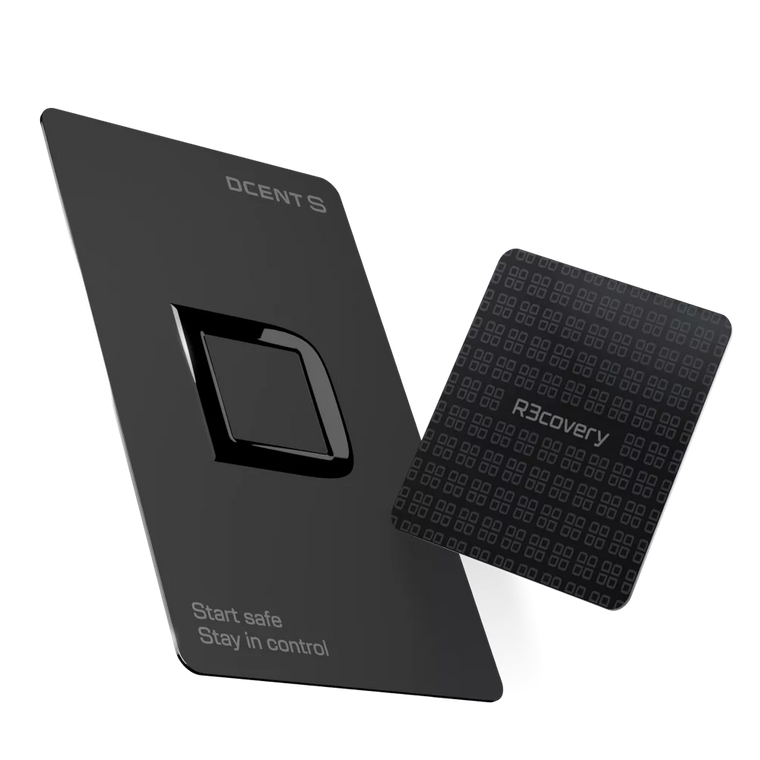
A hardware wallet like D'CENT stores your private keys on a dedicated secure chip that never connects directly to the internet, significantly reducing the risk of key theft through online attacks. However, a hardware wallet cannot protect against every risk. If a user signs a malicious transaction or falls for an approval-based phishing attack, losses can still occur. The device protects your keys; verifying what you sign is your responsibility.
What Bitcoin Proved in 2009
When Satoshi Nakamoto launched Bitcoin in January 2009, it wasn't just a new currency. It was a proof of concept: a fully functional financial system that operated without any central authority.
Bitcoin.org's whitepaper described "a purely peer-to-peer version of electronic cash" that would "allow online payments to be sent directly from one party to another without going through a financial institution." Before Bitcoin, decentralized digital money was a theoretical concept. After Bitcoin, it was a working system that has been running continuously for over 17 years without any centralized shutdown or permanent failure.
This proved that decentralization wasn't just a philosophical preference. It was a viable architecture for real financial systems.
Common Misconceptions About Decentralization
"Decentralized means no rules"
Decentralized networks have rules -- they're just enforced by code (protocol rules and consensus mechanisms -- the agreed-upon processes by which all participants validate transactions) rather than by a central authority. Bitcoin has strict rules about how many coins can exist, how transactions are validated, and how new blocks are created. The difference is that no single entity can change those rules unilaterally.
"Decentralization makes everything slower"
While Bitcoin's base layer processes up to roughly 7 transactions per second compared to Visa's thousands, this is a design choice that prioritizes security and decentralization. Layer 2 solutions -- additional networks built on top of the main blockchain to handle transactions faster -- (like the Lightning Network) can process transactions almost instantly. Speed and decentralization are a trade-off, not a binary choice.
"If it uses a blockchain, it's decentralized"
Not necessarily. Some blockchains are run by a small number of validators controlled by a single organization. A blockchain is a data structure. Decentralization is a property of how that data structure is governed and maintained. Always check who runs the nodes and who can change the protocol rules.
"Decentralization means you don't need to trust anyone"
More accurately, decentralization means you don't need to trust any single entity. You still trust the network's consensus mechanism, the open-source code, and the community of developers and validators. The difference is that this trust is distributed and verifiable, not concentrated and opaque.
Decentralization Readiness Checklist
Use this checklist to evaluate whether you're actually benefiting from decentralization:
- ☐ Understand the difference between distributed (data spread out) and decentralized (control spread out)
- ☐ Check where your crypto actually is -- if it's on a centralized exchange, you're exposed to single-point-of-failure risk
- ☐ Set up a self-custody wallet to hold your own private keys
- ☐ Store your Recovery Phrase offline -- write it on paper or metal, never store it digitally
- ☐ Verify every transaction before signing -- check the recipient address, network, and amount on your hardware wallet's display
- ☐ Review token approvals (Approval) regularly and revoke any you no longer need
- ☐ Research the decentralization level of any blockchain or protocol you invest in -- who controls the validators? Who can change the rules?
- ☐ Keep firmware updated on your hardware wallet and apply security patches promptly
- ☐ Never enter your Recovery Phrase on any website, app, or online form -- legitimate services will never ask for it
- ☐ Have a backup plan -- consider what happens to your assets if you lose access to your device (inheritance planning, trusted family member)
FAQ
Q1: If decentralization is so important, why do people still use centralized exchanges?
A: Centralized exchanges offer convenience -- easy fiat-to-crypto conversion, familiar interfaces, and customer support. Many newcomers start on exchanges because the onboarding process is simpler. The risk is that convenience comes with the trade-off of trusting a single entity with your funds. Experienced holders often use exchanges only for trading, then move assets to self-custody wallets for long-term storage.
Q2: Can a decentralized network be shut down by a government?
A: Major decentralized networks like Bitcoin and Ethereum are extremely resistant to shutdown because they run on thousands of independent nodes across dozens of countries. A single government could ban cryptocurrency activities within its borders, but it cannot "turn off" a global peer-to-peer network. The network would continue operating in every other country.
Q3: Is my crypto on a decentralized exchange (DEX) safer than on a centralized exchange (CEX)?
A: DEXs reduce one type of risk -- you trade directly from your own wallet, so the exchange never holds your funds. However, DEXs carry other risks, such as smart contract vulnerabilities and approval-based phishing. Neither option is risk-free; the risk profile is simply different.
Q4: What's the simplest way to start practicing self-custody?
A: Begin by setting up a hardware wallet. Transfer a small amount of crypto to it first, verify you can send and receive, and make sure you've securely stored your Recovery Phrase offline. Once you're comfortable with the process, gradually move more of your holdings to self-custody.
Q5: Does decentralization mean all my transactions are private?
A: No. On most public blockchains (like Bitcoin and Ethereum), all transactions are publicly visible. Decentralization means no central authority controls the network -- it does not mean your activity is hidden. Your transactions are linked to your wallet address, which is pseudonymous but not anonymous.
Q6: Can decentralization be reversed? Could Bitcoin become centralized?
A: In theory, if a small group gained control of the majority of Bitcoin's mining power (a "51% attack"), they could manipulate the network. In practice, Bitcoin's network is so large and widely distributed that this would require an impractical amount of resources. However, smaller blockchains with fewer validators are more vulnerable to centralization pressures.
Q7: What happens to my crypto if a hardware wallet manufacturer goes out of business?
A: Your crypto exists on the blockchain, not inside the hardware wallet. The wallet is just a device that stores your private keys. As long as you have your Recovery Phrase, you can restore your wallet on any compatible device from any manufacturer. This is why proper Recovery Phrase backup is so important.
Q8: How do I know if a blockchain project is actually decentralized?
A: Look at three things: (1) How many independent validators or miners run the network? (2) How is protocol governance structured -- can one team push changes unilaterally? (3) Is the code open-source and auditable? A project that checks all three boxes has a stronger claim to being genuinely decentralized.